



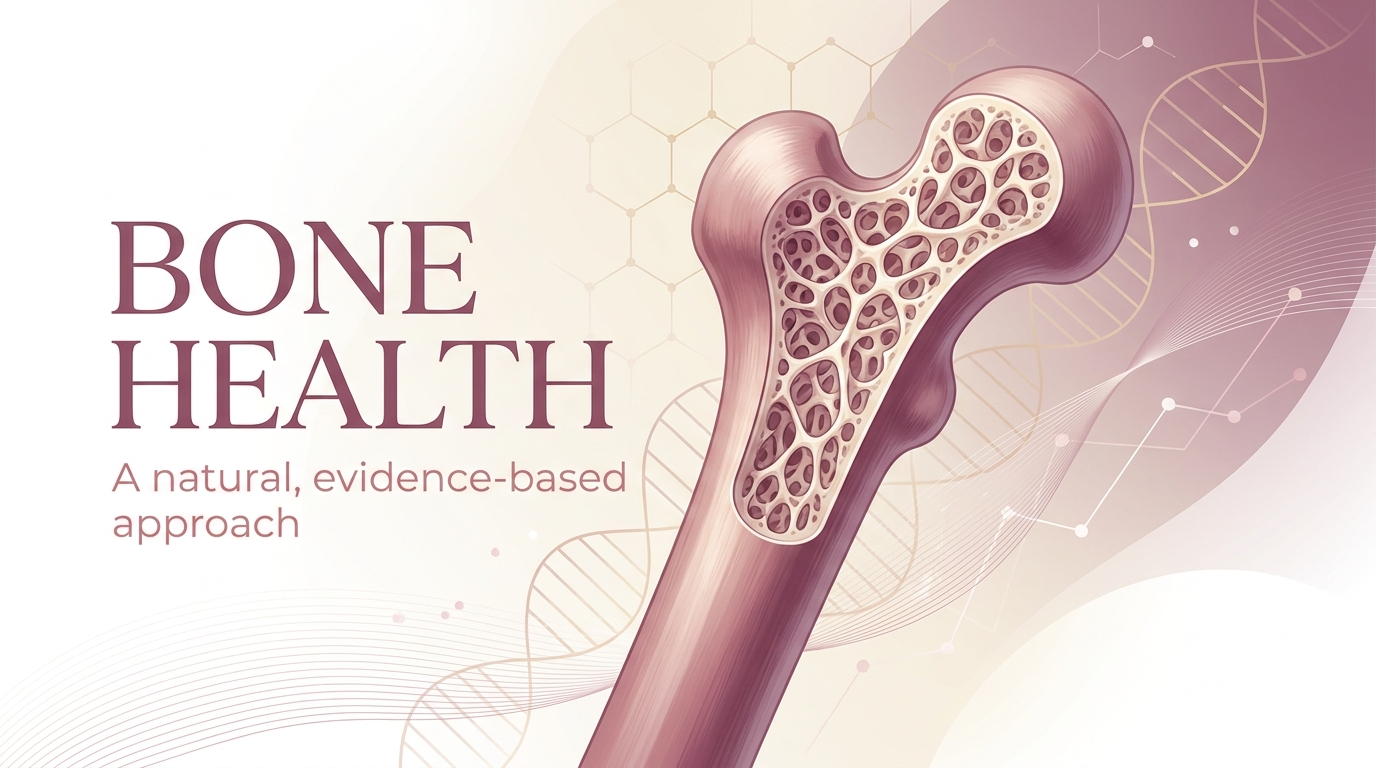
Bone loss is one of the quietest changes of the menopause transition. There's no symptom, no ache, no warning — until, for some women, a wrist or a hip breaks far too easily and the years of silent thinning finally make themselves known. In the five to seven years around menopause, a woman can lose up to 20% of her bone density. It's one of the most important reasons to act early, and the encouraging news is that bone is living tissue — it responds, at any age, to the way you feed, move and care for your body.
At Happy Healthy You we take a natural, whole-body view of bone health: understand why bones thin at this stage, calm the inflammation that's quietly driving it, and give your body the raw materials and signals it needs to keep rebuilding. Here's how.
Why bones thin at menopause — it's an inflammatory story
Your skeleton is constantly being remodelled. Cells called osteoblasts build new bone, while osteoclasts break old bone down. For most of adult life the two stay in balance. Menopause tips that balance toward breakdown — and oestrogen is at the centre of it.
Oestrogen is quietly bone-protective. It restrains the bone-dissolving osteoclasts and keeps inflammation in check. When oestrogen falls, two things happen at once. First, the brakes come off the osteoclasts, so bone is broken down faster than it's replaced. Second — and this is the part that's often missed — the body shifts into a state of chronic low-grade inflammation.
Researchers describe post-menopausal bone loss as, quite literally, "an inflammatory tale." As oestrogen declines, levels of inflammatory messengers such as IL-6, IL-1, TNF-α and RANKL rise. These cytokines drive the formation, activity and survival of osteoclasts, accelerating the loss of bone. In other words, the same menopausal inflammation that shows up as aching joints and a frozen shoulder is also working away inside your bones.
This is why a genuinely effective natural approach has to do more than just add calcium. It needs to address the hormonal shift, calm the inflammation, and supply the building blocks — all at once.
The prune research: small fruit, serious evidence
If there's one food with standout evidence for bone health, it's the humble prune (dried plum). This isn't folklore — it's some of the most rigorous nutrition research in the field.
In a landmark 12-month randomised controlled trial from Penn State (the Prune Study), 235 postmenopausal women were divided into three groups: no prunes, 50g a day (about 5–6 prunes), or 100g a day (about 10–12 prunes). The results were striking:
- Women eating prunes preserved bone mineral density at the hip, while the no-prune group lost bone over the year.
- Prune eaters showed reduced markers of bone breakdown, including TRAP-5b, a marker of osteoclast activity.
- Earlier work found that 100g of prunes daily improved bone density in the forearm and spine and lowered bone-turnover markers.
Researchers credit prunes' unusual combination of polyphenols and other bioactive compounds, vitamin K, boron, copper and potassium, which appear to work in part by dampening oxidative stress and inflammation — the very inflammatory drivers of menopausal bone loss. In short, prunes don't just deliver minerals; they help switch off the signals telling your body to dismantle bone.
The practical takeaway is refreshingly simple: aim for around 5–6 prunes a day. Introduce them gradually, and pair them with the rest of an anti-inflammatory, mineral-rich diet.
Nitric Oxide
There's another piece of the puzzle that's only recently come into focus: nitric oxide. Best known as the molecule that relaxes blood vessels and supports circulation, nitric oxide turns out to be a potent regulator of bone remodelling — and a key part of how your body decides whether to deposit minerals into bone or pull them back out. The problem is nitric oxide levels fall by 50% by the age of 50.
Here's why it matters for mineral balance. Your skeleton is the body's great mineral reservoir, holding the lion's share of its calcium and phosphate. Whether those minerals are being laid down into bone or withdrawn from it is governed by the balance between bone-building osteoblasts and bone-dissolving osteoclasts — and nitric oxide influences both. In response to oestrogen and to mechanical loading (the strain of exercise), bone cells release nitric oxide, which stimulates the bone-building osteoblasts while discouraging osteoclasts from attaching and resorbing bone. The net effect is to tip remodelling toward formation and mineral retention rather than loss.
Crucially, nitric oxide is part of the mechanism by which oestrogen protects your bones — in studies, oestrogen's bone-building effects are blunted when nitric oxide production is blocked. As oestrogen falls through menopause, nitric oxide signalling falls with it, and that's one more reason mineral balance shifts toward loss. Preclinical research has shown that supporting nitric oxide can improve bone formation, increase bone strength, and help prevent oestrogen-deficiency bone loss.
Here are some quick, practical tips you could drop into the article as a callout box:
Quick ways to boost your nitric oxide naturally
- Eat your nitrate-rich greens — beetroot, rocket (arugula), spinach, silverbeet and celery are the richest dietary sources your body converts into nitric oxide.
- Move every day — brisk walking, dancing and especially resistance training are among the strongest natural triggers for nitric oxide release in blood vessels and bone.
- Get some sunshine — sunlight on your skin activates nitric oxide pathways (a lovely reason for a daily walk outdoors).
- Look after your mouth — harsh antibacterial mouthwash wipes out the oral bacteria that convert dietary nitrate into nitric oxide, so go gentle.
- Breathe through your nose — nasal breathing (and even humming) increases nitric oxide delivery; mouth-breathing bypasses it.
- Add polyphenol-rich foods — dark berries, pomegranate, citrus and a little dark chocolate help protect nitric oxide from breaking down.
- Keep moving warm — sensible heat (a warm bath or sauna) and staying active both support healthy circulation and nitric oxide production.

The Happy Healthy You natural approach to bone
Food first, always — but targeted natural support helps cover the gaps that diet alone often can't, especially when hormones and inflammation are working against you. Three Happy Healthy You formulas line up directly with the three drivers of menopausal bone loss.
Happy Hormones — supporting the hormonal foundation
Because falling oestrogen is the root trigger of menopausal bone loss, supporting hormonal balance is foundational. Happy Hormones is a blend of traditional Western herbal medicines and superfoods — including black cohosh, chasteberry (Vitex), red clover, sage, maca and wild yam — that helps the body find its own balance through the transition. Several of these herbs, particularly red clover, are sources of phyto-oestrogens — plant compounds with a gentle oestrogen-like activity that the body can draw on as its own production declines. By supporting the hormonal terrain, Happy Hormones works at the level where bone loss actually begins.

Happy Collagen — rebuilding the bone matrix
We tend to think of bone as pure mineral, but roughly a third of it is collagen — the protein scaffold that calcium and other minerals are laid down upon. As oestrogen falls, collagen synthesis slows, and the scaffold itself weakens. Happy Collagen supplies hydrolysed collagen peptides alongside vitamin C (an essential cofactor for collagen production), zinc, prebiotic fibre and probiotics. The evidence here is meaningful: a one-year study found 5g of collagen peptides daily produced a statistically significant increase in bone mineral density at the spine and femoral neck — exactly the high-risk sites for menopausal fracture. Collagen rebuilds the framework; minerals fill it in.

MSP — magnesium and the anti-inflammatory layer
Magnesium is one of the most under-appreciated bone nutrients: around 60% of the body's magnesium is stored in bone, and it's essential both for bone structure and for activating vitamin D, without which calcium can't be properly absorbed. MSP (Magnesium, Sleep, Pain) delivers several highly absorbable forms of magnesium, and pairs them with turmeric and boswellia — two of nature's best-studied anti-inflammatory botanicals. That combination is doubly useful for bone: magnesium supplies a key structural mineral, while turmeric and boswellia help calm the very inflammation that drives osteoclast activity. As a bonus, magnesium supports the deep, restorative sleep during which much of the body's repair takes place.

Managing inflammation — the thread that ties it together
Notice the common thread: oestrogen support, collagen rebuilding and magnesium all sit on top of a strategy to lower inflammation. This is the heart of the Happy Healthy You philosophy — reduce the body's inflammatory and oxidative load (through anti-inflammatory foods, turmeric, boswellia, prunes and lifestyle) so the body can return to its natural state of building rather than breaking down. Bone health isn't a single nutrient; it's an internal environment.
Diet and lifestyle: the foundations that hold it all up
Supplements work best on top of the Four Pillars of Health from the Happy Healthy You book — and several everyday habits are non-negotiable for bone.
Eat for your bones. Beyond your daily prunes, build meals around calcium-rich plant foods (leafy greens, bok choy, broccoli, tahini, almonds, sardines with bones, natural yoghurt), vitamin K from greens (which directs calcium into bone), and adequate protein, which forms the collagen matrix. Lean into the book's anti-inflammatory, plant-predominant plate — aim for around 30 different plant foods a week — and reduce the bone-robbers: excess sugar, alcohol, salt, soft drinks and caffeine.
Get your vitamin D. Vitamin D is essential for absorbing calcium, and many Australian women are low, especially in winter. Sensible sun exposure plus, where needed, testing and supplementation under your practitioner's guidance makes a real difference.
Load your bones. Bone is built by demand. Resistance/strength training 2–3 times a week and weight-bearing movement (brisk walking, dancing, hiking) signal your body to lay down new bone — and build the muscle that protects you from falls. This is the single most powerful lifestyle lever you have.
Protect sleep and lower stress. Repair happens overnight, and chronic stress (high cortisol) actively breaks bone down. The book's foundations — protected sleep, daily breathwork, meditation and time in nature — lower cortisol and create the calm internal environment in which bone can rebuild.
Putting it together
Menopausal bone loss is silent, but it is not inevitable, and it is not beyond your influence. It's driven by falling oestrogen and the inflammation that follows — so the natural answer is to meet it on every level:
- Eat 5–6 prunes a day, within an anti-inflammatory, mineral-rich, plant-predominant diet.
- Happy Hormones to support the hormonal foundation where bone loss begins.
- Happy Collagen to rebuild the collagen scaffold your minerals depend on.
- MSP for magnesium and to calm the inflammation that drives bone breakdown.
- Strength training, weight-bearing movement, vitamin D, protein, protected sleep and lower stress as the everyday foundation.
- Focus on boosting Nitric Oxide levels naturally
Your bones are alive, and they are listening. Give them the right environment, and they will keep rebuilding — for decades to come.
This article is for general education and is not a substitute for individual medical advice. Herbal ingredients are used in accordance with their traditional use in Western herbal medicine. If you have osteopenia, osteoporosis, or a strong family history of fracture, please work with your GP or healthcare practitioner — a bone density (DEXA) scan and individualised plan are worthwhile. Always check with your practitioner before starting new supplements, particularly if you're on medication. To find the right combination for your stage and symptoms, take the assessment at happyhealthyyou.com.au.
References & further reading
The prune research
- Penn State — Prunes may help prevent bone loss and preserve bone strength — https://www.psu.edu/news/health-and-human-development/story/prunes-may-help-prevent-bone-loss-and-preserve-bone-strength
- Prunes preserve hip bone mineral density in a 12-month randomized controlled trial in postmenopausal women: the Prune Study, American Journal of Clinical Nutrition — https://ajcn.nutrition.org/article/S0002-9165(23)03609-2/fulltext
- Bone-Protective Effects of Dried Plum in Postmenopausal Women: Efficacy and Possible Mechanisms — https://www.ncbi.nlm.nih.gov/pmc/articles/PMC5452226/
- Dried Plums, Prunes and Bone Health: A Comprehensive Review — https://www.ncbi.nlm.nih.gov/pmc/articles/PMC5409740/
Oestrogen, inflammation and bone loss
- Estrogen deficiency and bone loss: an inflammatory tale — https://pmc.ncbi.nlm.nih.gov/articles/PMC1451218/
- Osteoporosis Due to Hormone Imbalance: Effects of Estrogen Deficiency on Bone Turnover — https://pmc.ncbi.nlm.nih.gov/articles/PMC8836058/
- T-Cell Mediated Inflammation in Postmenopausal Osteoporosis, Frontiers in Immunology — https://www.frontiersin.org/journals/immunology/articles/10.3389/fimmu.2021.687551/full
Happy Healthy You products & education
- Happy Collagen — https://happyhealthyyou.com.au/products/happy-collagen
- How does collagen help menopause — https://happyhealthyyou.com.au/blogs/articles/why-you-need-collagen-in-menopause
- Happy Hormones — https://happyhealthyyou.com.au/products/happy-hormones
- MSP (Magnesium, Sleep, Pain) — https://happyhealthyyou.com.au/products/msp-magnesium-sleep-pain
- Is magnesium good for arthritis & joint health — https://happyhealthyyou.com.au/blogs/articles/is-magnesium-good-for-arthritis
- Happy Healthy YOU (book) — Jeff Butterworth & Lisa Curry: the Four Pillars of Health framework
Nitric oxide and bone
- Nitric Oxide and Cyclic GMP Functions in Bone — https://pmc.ncbi.nlm.nih.gov/articles/PMC9990405/
- Nitric oxide modulates bone anabolism through regulation of osteoblast glycolysis and differentiation, JCI — https://www.jci.org/articles/view/138935
- Regulation of Bone Mass and Bone Turnover by Neuronal Nitric Oxide Synthase, Endocrinology — https://academic.oup.com/endo/article/145/11/5068/2500374



Leave a comment
This site is protected by hCaptcha and the hCaptcha Privacy Policy and Terms of Service apply.