


Many women go through life with a weak core and become oblivious about the importance of this muscle group, often until any kind of problem is presenting. Problems that are commonly associated with a weak core and in particular a weak or dysfunctional pelvic floor include:
- reduced bladder control
- prolapse
- reduced sexual sensation
- pelvic pain
- difficulty emptying the bowels
The function of the pelvic floor can also be affected by other factors such as pregnancy and childbirth, injury, ongoing constipation, excessive heavy lifting, excessive core work, poor posture and being overweight.
Function of the Pelvic Floor
The pelvic floor muscles stretch from the pubic bone to the tailbone like a hammock over the base of the pelvis and are a part of, what I like to call, the most important muscle group within our body – the inner core.
The inner core consists of the primary breathing muscle (diaphragm), the deep abdominal muscles (transversus abdominis), the deep back muscles running along your spine (multifidus) and the pelvic floor muscles (levator ani and perineum). These all work in harmony to support the spine and control movements of the hip and the sacroiliac joint.
- The front part of the pelvic floor muscles controls the bladder while the back part controls the rectum. These are often the easiest to engage as we use them regularly. However, the centre point of the pelvic floor muscles (perineum) is just as important. Together they support the pelvic organs.
- The pelvic floor muscles play a central role in optimal sexual function, sexual sensation and arousal and when functioning the way they should, help to maintain libido.
- The pelvic floor muscles act as a blood and lymph pump for the pelvis for healthy blood flow and drainage of fluids and toxins to prevent pelvic congestion.
- The pelvic floor muscles help to control the downward pressure inside the abdomen while lifting heavy weight.
- When breathing correctly, the pelvic floor muscles work in harmony with the diaphragm, expanding with inhalation and gently contracting with exhalation.

By learning how to control your pelvic floor muscles, you bring circulation to the pelvic area, create a better environment for the healing of tissues, and improve the function of the pelvis and core.
Just as any other muscle in our body, the pelvic floor muscles need to be used regularly to stay functional. However, since it may be hard to know when or how to engage the pelvic floor muscles they tend to become either weak or hyper-toned.
Learning how to strengthen, stabilize, stretch and soften the pelvic floor is essential to create the correct foundation for each movement in the body. It is also a basic tool to avoid loss of energy from this important area.
Restoring and Maintaining Pelvic Floor Function
As mentioned above, the pelvic floor can be either too tight or too loose. Either way, both need to be addressed. You may have to find what exercises work for YOU to be able to relax your pelvic floor but still keep them well-toned. So we want to strengthen, stabilize, stretch and soften the pelvic floor to create a healthy foundation for all other movements; additionally, we want to enhance the flow of energy, improve the flow of hormones and flush toxins.
Increase awareness
Improving pelvic floor function can be tricky if you don’t know how to engage the muscles involved. The first step is to become aware of what is going on in this area of your body to be able to engage and relax the muscles.
Lying down on your back, scan through the entire body. Rest your attention around your pelvis and take note of any sensations or emotions that arise. How do you feel? Are you holding a lot of tension in this area? Is there a lack of energy or do you feel highly energised?
Deep diaphragmatic breathing
You may have heard before about all the amazing benefits of deep diaphragmatic breathing such as reduced stress levels, improved digestion, improved lymphatic function, improved detoxification, improved blood flow, reduced chronic inflammation, and increased energy and well-being.
Did you know that when we breathe deeply and fully, it also gently stretches and massages the pelvic floor muscles?
When we use deep diaphragmatic breathing, the pelvic floor moves together with the diaphragm. As we inhale the diaphragm moves downward, then the abdomen gentle expands and pelvic floor muscles stretch. When we exhale, the diaphragm moves up and the pelvic floor muscles release, lift and gently contract.
Many people who experience a hyper-toned pelvic floor often use shallow, thoracic breathing because of the tension in their lower belly and lower back. Doing these exercises are really effective to help with a hypertonic pelvic floor.

To do this exercise you will need a yoga mat or blanket to lie on and a bolster or a pillow for support under your knees.
- Start by lying down on your back with the bolster under your knees. Make sure that your heels are in contact with the ground, relax your arms along the side or even on top of your lower belly. Make sure that your lower back relaxes down.
- Allow your natural breathing pattern to emerge. Place your hands on top of your pelvis and start breathing into your hands.
- Exhale completely and inhale deeply. Channel your breath all the way towards your pelvic floor and lower abdomen and feel the lower belly rising. Exhale slowly and relax.
- As you continue this deep breathing, start to feel into your pelvic floor, trying to feel the sensations of your pelvic floor muscles expanding and gently stretching as you inhale, then relaxing back as you exhale.
Doing this breathing exercise for a few minutes a day not only helps to soften, stretch and relax a hypertonic pelvic floor; it also builds more awareness around this area of your body.
Releasing tension and increasing circulation
We also want to make sure that we maintain the circulation flowing in the pelvis. Doing gentle dynamic movements with the hips will help to release tension and increase circulation. This can be done in a few different ways. You can be standing and just move your pelvis around in circles in the formation of the number 8 or simply tilt the pelvis forth and back. It can also be done while sitting in a cross-legged position and moving your upper body around in circles, leading from your hips. Use slow movements, allowing your body to guide you.
*Some women with very tight pelvic floor muscles may even see a specialist and get a trigger point release from within.
Engaging the Pelvic Floor Muscles
Let’s move on to engaging and strengthening the pelvic floor muscles. As mentioned above, it is equally important to be able to engage them correctly as it is to relax them. Kegels which can be practised in many different ways are really effective here.

-
Engaging the back part of the pelvic floor
Sit on a bolster with the pelvis levelled and supported. Start by contracting the back part of the pelvic floor, controlling the rectum. Take a deep inhalation. With an exhalation, draw the rectum in and close the anus. Relax with inhalation.
-
Engaging the front part of the pelvic floor
Now bring focus to the front part of the pelvic floor, controlling the bladder muscles. Take a deep inhalation. With an exhalation, contract the bladder muscles gently and lift. Relax with inhalation.
-
Engaging the centre of the pelvic floor
Find contact with the perineum muscles, which is the centre of your pelvic floor. Continue with the same pattern. Take a deep inhalation to prepare. Gently contract the perineum and lift up, exhale and release.
-
Engaging all parts of the pelvic floor
Bring all the movements together. Inhale to prepare. Exhale, contract and lift the anus, the bladder muscles, and the perineum, gently squeezing lower belly in. Inhale and relax.
These exercises can be done regularly, with 2-3 repetitions each.
-
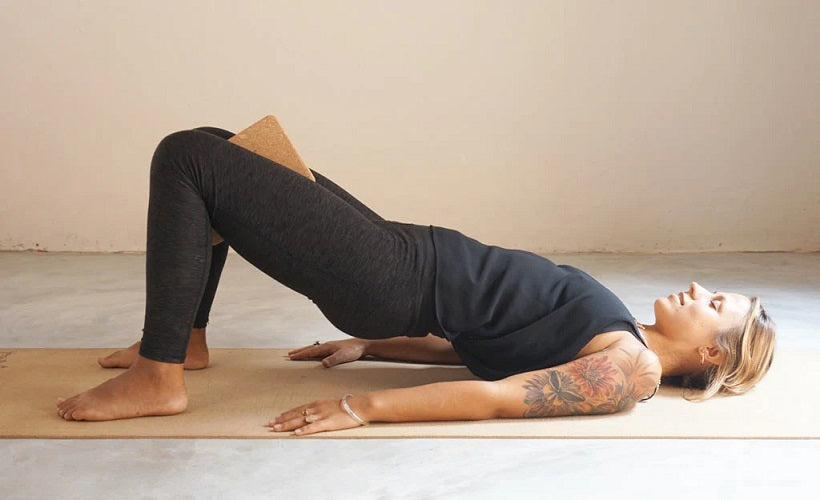
Engagement in bridge pose
Lying down on your back, place the feet firmly on the ground with a block between your thighs close to the knees. Press the feet into the ground, squeeze the block and lift the pelvis off the floor.
Roll the buttocks together and draw the rectum in. Draw the bladder down and in, contract the anus, perineum, and sphincter muscle in the bladder. Gently bring the hipbones together, contracting the lower belly. Hold and take 2-5 deep breaths. Release down and tip your knees side to side to release tension. Repeat 3-5 times.

Improving Posture
Our posture also affects how well our pelvic floor is functioning. Poor posture can make the pelvic floor muscles weak. Therefore, improving our posture when we are standing, walking and sitting can help to maintain healthy pelvic floor function. The exercises above will help to improve posture but simply paying more attention to how you position yourself in a natural, relaxed state can tell a lot on why you may have certain physical issues.
- In a natural standing position start by paying attention to your natural posture. Where do you tend to keep more weight, towards the heels or the toes? Is the weight equally balanced between the two feet?
- Start moving the weight towards your toes and notice how this changes the sensation in your pelvic floor muscles. Then do the opposite, moving the weight towards your heels. Notice the difference.
- Find a stable posture with the weight equally distributed over both feet, rooting your feet down. Unlock the knees, relax your abdomen, lengthen through your spine and the crown of your head. Feel the energy moving up through your pelvic floor and spine.
- Continue deep breathing here and stay for 1-3 minutes.
Summary
A healthy and functional pelvic floor is an essential part of our wellbeing. Many women walk through life with very little awareness of their pelvic floor. Raising this awareness and restoring pelvic floor function can help to address incontinence issues, enhance sexual function and libido, improve blood flow circulation and increase drainage of fluids and toxins to prevent pelvic congestion and pelvic pain.


Leave a comment
This site is protected by hCaptcha and the hCaptcha Privacy Policy and Terms of Service apply.